
Gothic home décor looks most sophisticated when it relies on atmosphere rather than novelty. Deep colors, architectural forms, aged finishes, dramatic lighting, and tactile fabrics can make an ordinary room feel collected and distinctive without turning it into a stage set.
The secret is restraint. One commanding mirror, a pair of sculptural candleholders, or beautifully hung velvet curtains will usually create more impact than a room crowded with themed objects. The following pieces offer a practical foundation for creating a modern Gothic interior that feels elegant, personal, and considerably more expensive than it needs to be. For a broader look at the aesthetic, explore The New Gothic: Modern Luxury
What Makes Gothic Décor Look Expensive?
Luxury is rarely about filling every surface. Expensive-looking rooms repeat a controlled palette, balance decorative pieces with negative space, and combine contrasting textures such as velvet, metal, glass, wood, and stone.
Look for substantial proportions, restrained ornamentation, convincing finishes, and materials that interact beautifully with light. Matte black, antique brass, oxblood, charcoal, aged silver, dark walnut, forest green, and muted plum are especially effective when used consistently.
1. An Ornate Black Mirror
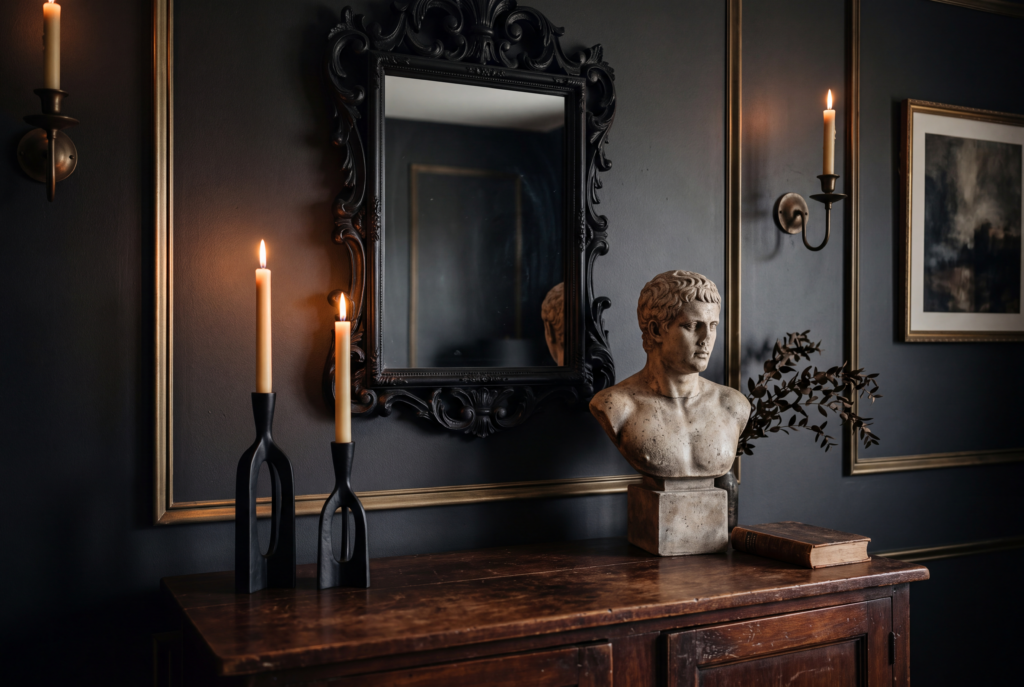
An oversized mirror is one of the quickest ways to give a room architectural presence. A black or antique-finished frame introduces Gothic detail while the reflective surface keeps the space from feeling closed in.
Choose a design with an arched top, carved corners, or restrained Baroque ornamentation. The frame should appear substantial without overwhelming the wall. Place it over a console, fireplace, or dresser, or lean a tall version against the wall for a more relaxed effect.
2. Sculptural Candleholders
Candleholders provide height, shadow, and a sense of ceremony even when no candles are burning. Antique-brass, matte-black, wrought-iron, and aged-silver finishes tend to look more refined than highly polished metal.
Arrange candleholders in uneven groups of three, varying their heights while keeping the finish consistent. Slim taper candles in black, ivory, burgundy, or deep green create drama without relying on obvious Halloween imagery.
3. Floor-Length Velvet Curtains
Velvet curtains soften sound, filter light, and instantly make a room feel more substantial. Their depth and movement work particularly well in Gothic interiors, where texture matters as much as color.
Black can be striking, but charcoal, oxblood, aubergine, midnight blue, and forest green are often easier to live with. Hang the curtain rod above the window and extend it beyond the frame. Letting the panels reach the floor makes ceilings appear taller and windows larger.
4. Dark Botanical Wall Art
Moody botanical artwork brings natural beauty into a dark room without disturbing its atmosphere. Look for shadowed florals, antique scientific illustrations, nocturnal gardens, or desaturated still-life compositions.
A single large print creates a strong focal point, while a coordinated set can form a gallery wall. Use black, dark wood, or antique-gold frames with generous matting. Avoid mixing too many frame styles—the repetition is what makes the display feel intentional.
5. A Classical Bust or Stone-Look Sculpture
A small classical sculpture gives a shelf or console the quiet authority of an old library. It does not need to be genuine stone. A well-shaped resin or plaster piece in an aged, matte finish can provide the same visual effect.
Display one sculpture rather than a crowded collection. Place it beside stacked books, beneath a picture light, or against a dark wall where its profile can cast a dramatic shadow.
6. Jewel-Toned Velvet Cushions
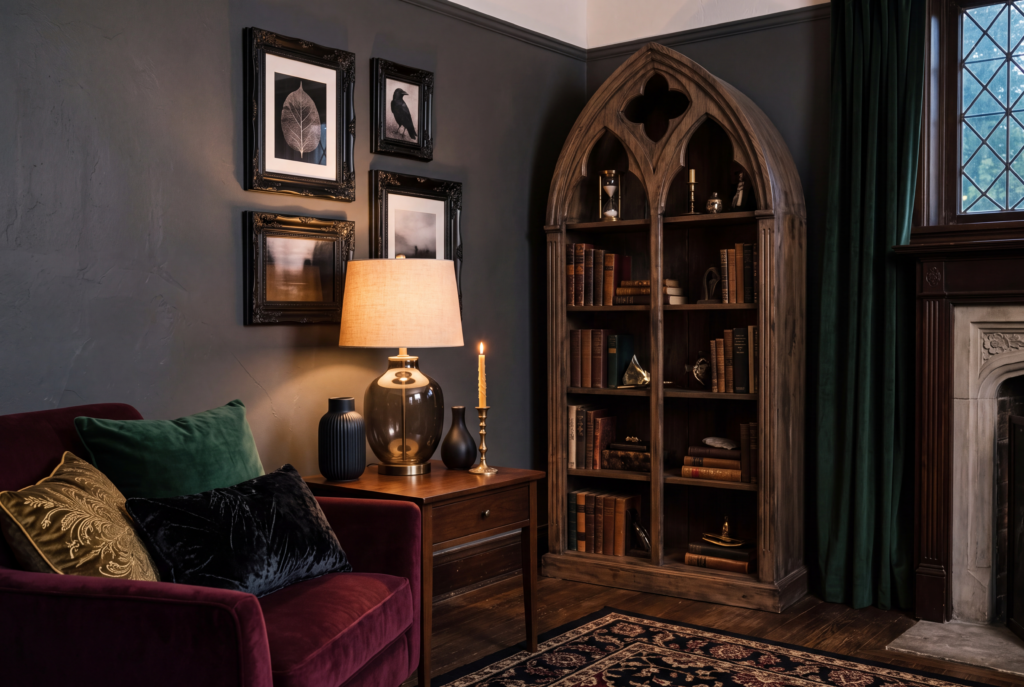
Velvet cushions offer an affordable way to introduce rich color and texture. Deep plum, garnet, emerald, midnight blue, and black can all work within a modern Gothic palette.
Choose covers with piping, subtle pleating, or a clean knife edge. Mix two or three complementary colors rather than buying an overly coordinated set. Feather-style inserts with generous filling create a fuller, more polished silhouette.
7. Smoked-Glass Lighting
Lighting determines whether a dark room feels atmospheric or simply dim. Smoked glass diffuses light softly while introducing a mysterious reflective quality that works beautifully with black metal and antique brass.
Consider a pendant, table lamp, or wall sconce with a simple silhouette. Warm bulbs generally complement Gothic interiors better than stark white light. Layer several smaller light sources instead of relying entirely on one bright ceiling fixture.
8. Gothic-Arch Shelving
A pointed arch immediately references Gothic architecture, but it can still feel contemporary when the design is clean, and the finish is restrained. An arched shelf or cabinet creates a strong vertical line and provides a natural place for a carefully edited collection.
Leave breathing room between objects. Combine books, a small plant, framed art, and one sculptural piece instead of filling every shelf. The architecture of the furniture should remain visible.
9. Antique-Style Picture Frames
Decorative frames can make inexpensive prints and personal photographs feel like part of a collected interior. Look for narrow carved borders, antique-brass tones, dark wood, or distressed black finishes.
For a sophisticated arrangement, repeat one finish in several sizes. Black-and-white portraits, architectural studies, vintage botanical prints, and small oil-style landscapes all suit the mood without appearing overly themed.
10. Matte-Black Ceramic Vases
A matte-black vase has enough visual weight to stand alone, making it useful for shelves, dining tables, and entry consoles. Its simple surface also provides a calm counterpoint to more ornate Gothic elements.
Fill it with bare branches, eucalyptus, dried burgundy foliage, or a restrained arrangement of deep-colored flowers. Choose an organic or slightly irregular silhouette to avoid making the room feel too formal.
11. An Ornate Vanity or Serving Tray
A decorative tray turns ordinary objects into a deliberate arrangement. On a dresser, it can hold perfume bottles and jewelry. On a coffee table, it can group a candle, a small book, and a dark glass vessel.
Antique brass, aged silver, black metal, and mirrored finishes work particularly well. Select a tray with enough detail to be interesting but enough open surface to remain useful.
12. Architectural Bookends
Bookends provide function while adding sculptural form to a shelf. Designs inspired by arches, ravens, classical columns, hands, celestial symbols, or dark stone can reinforce the room’s identity without consuming much space.
Choose a pair with enough weight to support real books. Position them around a tightly edited selection of literature and leave some surrounding space so the shapes remain visible.
13. A Dark Vintage-Style Area Rug
A rug anchors furniture and gives the room a finished foundation. Traditional patterns in charcoal, burgundy, faded black, muted gold, or deep blue can introduce history and detail without requiring expensive antique textiles.
Scale matters more than decoration. In a living room, the front legs of the main seating should normally rest on the rug. A rug that is too small can make even beautiful furniture look disconnected.
14. A Dramatic Table Lamp
A table lamp can function like sculpture while improving the room’s evening atmosphere. Look for black pleated shades, antique-metal bases, carved forms, or dark marble effects.
Place the lamp where its glow can illuminate artwork, books, or textured fabric. A pair creates symmetry on a console or bedside tables, while one unusual lamp can become a focal point in a reading corner.
15. A Luxurious Dark Throw
A generously sized throw introduces softness to rooms dominated by wood, glass, and metal. Velvet, faux mohair, chenille, or a substantial woven fabric can make a sofa or bed look more inviting.
Choose charcoal, black, wine, deep green, or muted plum. Drape it loosely rather than folding it into a perfect rectangle. The slight informality keeps the room comfortable and prevents the design from feeling staged.
A Simple Formula for an Expensive-Looking Gothic Room
Begin with one architectural statement, such as an ornate mirror or arched shelf. Add one rich textile, one sculptural lighting source, and one aged-metal accent. Finish with books, artwork, and a natural element such as branches or dark foliage.
Repeat two or three colors throughout the room and resist filling every empty space. Gothic style becomes more convincing when each object has room to create its own silhouette and shadow.
What to Avoid
- Too many novelty motifs: Skulls, bats, ravens, and occult symbols have more impact when used sparingly.
- Flat overhead lighting: Layer table lamps, sconces, and candles to produce depth.
- Furniture that is too small: Proper scale often looks more luxurious than elaborate decoration.
- Mixing every metal finish: Repeating one or two finishes creates visual continuity.
- Buying everything at once: A slowly collected room generally feels more authentic.
Final Thoughts
An elegant Gothic interior does not require a historic mansion or an extravagant budget. It requires a clear palette, a few strong silhouettes, and careful attention to texture, proportion, and light.
Start with the piece that would make the greatest difference in your room. Add the remaining layers gradually, choosing objects that are useful, visually distinctive, and consistent with the atmosphere you want to create. The result should feel dark and dramatic, but also comfortable enough for everyday life.
Frequently Asked Questions
Can Gothic home décor work in a small room?
Yes. Use one strong focal point, keep smaller surfaces uncluttered, and include mirrors or reflective glass to move light around the room. A limited color palette will also make the space feel more cohesive.
Does Gothic décor have to be completely black?
No. Charcoal, oxblood, plum, forest green, midnight blue, dark walnut, aged brass, and warm ivory can create a richer and more livable palette than black alone.
How can I keep Gothic décor from looking like Halloween decoration?
Prioritize architectural shapes, substantial textiles, artwork, books, and convincing finishes. Use recognizable seasonal motifs sparingly and balance them with simpler pieces.
Which Gothic décor item should I buy first?
Choose the item that solves the largest visual problem in the room. An ornate mirror can fill an empty wall, velvet curtains can soften a stark window, and layered lighting can transform an uncomfortable atmosphere.
[…] for more interior inspiration? Explore our Gothic Home Décor Guide for more ways to create a darker atmosphere at […]