
Modern Gothic architecture does not require a medieval castle, a cathedral ceiling, or a room filled with antique ornament. Its power comes from something more fundamental: the deliberate use of height, shadow, material, light, and silence to shape emotion.
A contemporary gallery with towering concrete walls can feel Gothic. So can a narrow hotel corridor, a dark-paneled library, or a minimalist room where one tall window controls every line of light. The architecture becomes Gothic not because it copies the past, but because it understands atmosphere.
The atmosphere test: If removing the furniture would leave the room just as emotionally powerful, the architecture is doing the real work.
Modern Gothic architecture is a principle not a reproduction
Historic Gothic architecture is associated with pointed arches, ribbed vaults, flying buttresses, tracery, pinnacles, and spires. These features were not merely decorative. They worked together to create buildings of unusual height, structural openness, and dramatic light. The Royal Institute of British Architects identifies these elements as central to the Gothic architectural language.
A modern space does not need to reproduce every one of those features. It can translate their intentions instead: lift the eye, frame the light, reveal the structure, exaggerate the threshold, and make material feel permanent.
1. Verticality changes the body
Height is one of architecture’s most immediate emotional tools. Tall windows, narrow openings, elongated columns, full-height curtains, and shelving that reaches the ceiling all encourage the eye to move upward.
This upward movement changes how a person experiences a room. A low ceiling can feel intimate and protective. A tall space can feel ceremonial, humbling, or slightly unsettling. Modern Gothic architecture uses that tension deliberately.
Modern interpretation: use one or two continuous vertical lines rather than covering the room with decorative arches. A tall doorway or a single narrow window can carry more authority than repeated imitation-Gothic details.
2. The pointed form creates direction
The pointed arch is one of the most recognizable features of Gothic architecture, but its visual power extends beyond the arch itself. A point gives the eye direction. It suggests ascent, focus, and a transition between one condition and another.
In a contemporary building, that idea might appear through a sharply pitched roof, an angular doorway, a narrow peaked niche, or furniture whose lines repeat the architecture without copying it literally.
Modern interpretation: choose one pointed or sharply angled element and allow it to become the room’s structural punctuation. Repetition can quickly turn elegance into a theme.
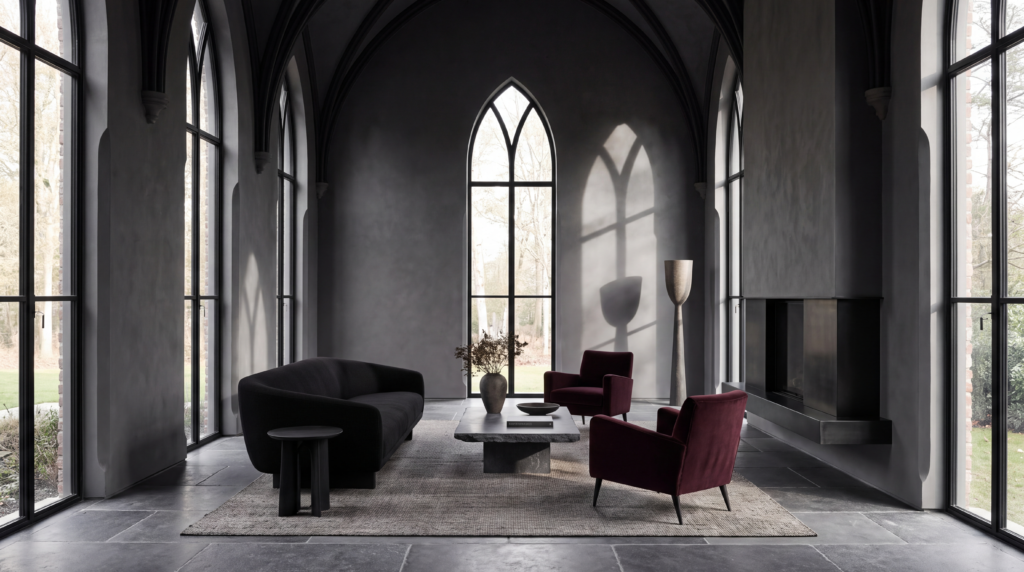
3. Light should be framed, not flooded
Gothic architecture is often remembered as dark, yet many of its greatest spaces were designed around transformative light. Structural innovations allowed walls to open for larger areas of stained glass, turning daylight into color, pattern, and meaning. The Metropolitan Museum of Art’s Gothic Art overview traces this relationship between structure, windows, and illumination.
The modern lesson is not to make every room brighter. It is to control where brightness appears. Light becomes more powerful when it enters through a defined opening, touches one textured surface, or isolates an important object.
Modern interpretation: combine concealed lighting with one visible source. A narrow skylight, shaded wall lamp, or low amber pool of light can create hierarchy without leaving the room unusably dark.
4. Shadow gives structure and depth
Flat, uniform lighting removes much of architecture’s emotional dimension. Shadow reveals recesses, thickness, edges, and the distance between surfaces. It allows a wall to feel substantial and a doorway to feel like a true passage.
This is why a completely black room is not automatically Gothic. Without variation, black can become visually empty. The stronger approach uses several depths of charcoal, brown-black, stone, and oxblood so that edges remain visible as the light changes.
Modern interpretation: light surfaces from the side instead of directly from the front. Grazing light across plaster, wood, brick, or concrete makes the material part of the composition.
5. Materials should carry memory
Stone, dark timber, aged metal, lime plaster, glass, and heavy fabric feel compelling because they reveal texture and time. Even in a newly built space, materials can suggest permanence when their natural character remains visible.
The principle resembles building a modern Gothic capsule wardrobe: a restrained palette becomes interesting through differences in surface. Polished stone reflects. Unfinished timber absorbs. Velvet softens. Blackened steel defines an edge.
Modern interpretation: place rough and refined materials beside each other. Honed stone against velvet or dark wood beside brushed metal creates more depth than adding ornamental objects everywhere.
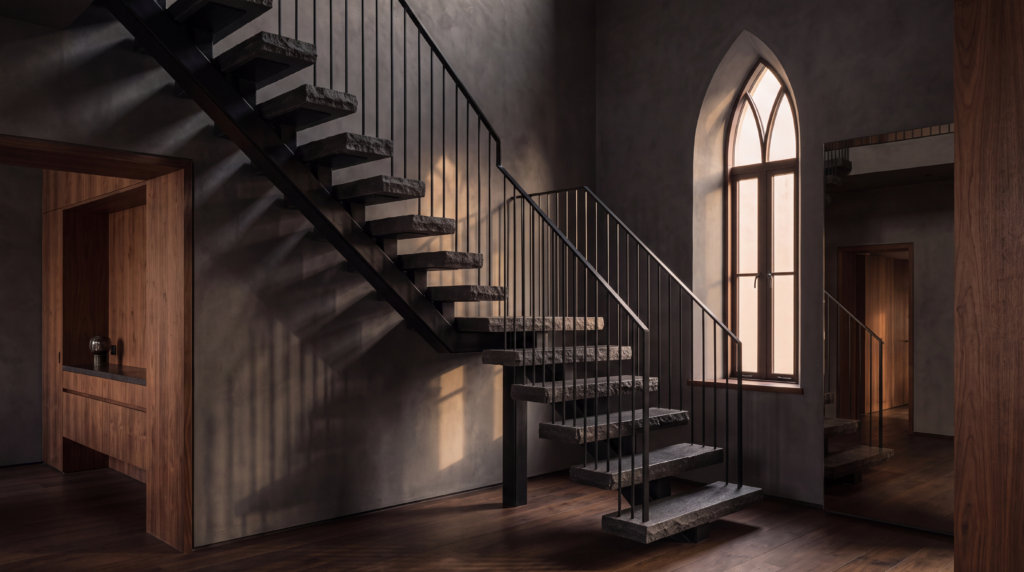
6. Thresholds make arrival meaningful
A powerful space does not reveal everything at once. Corridors, vestibules, stairs, screens, curtains, and framed doorways slow the transition from one area to another. They allow architecture to build anticipation.
Modern buildings often remove boundaries in pursuit of openness. Gothic atmosphere can return when a space includes moments of compression and release: a narrow entrance opening into a tall room, a dark hallway ending in daylight, or a concealed doorway leading to a private interior.
Modern interpretation: create one deliberate pause before the main room. The feeling of discovery is more important than an elaborate entrance.
7. Restraint makes darkness believable
The most convincing modern Gothic spaces resist the urge to announce themselves. They do not require gargoyles, artificial cobwebs, imitation tombstones, or a collection of unrelated medieval symbols.
Instead, they establish a clear architectural idea and repeat it quietly. One arch shape, one dominant material, one controlled color accent, and one strong source of light may be enough.
This is the architectural equivalent of the modern Gothic beauty code: depth comes from precision rather than excess.
How to translate Gothic atmosphere into a modern room
You do not need to renovate an entire building. Begin by identifying what the room already does well, then strengthen that quality.
- Choose one architectural line: emphasize the tallest window, doorway, column, or wall.
- Build a layered dark palette: combine black with charcoal, walnut, stone, oxblood, or muted plum.
- Control the lighting: use several low sources instead of one harsh ceiling fixture.
- Limit decorative symbols: allow material, proportion, and shadow to establish the mood.
- Preserve negative space: an empty wall or quiet corner gives important objects more authority.
Three modern Gothic space formulas
The shadowed library
Use floor-to-ceiling dark wood shelving, a warm reading lamp, one deep upholstered chair, and a restrained collection of books and objects. Keep the center of the room open so the walls provide the drama.
The monastic bedroom
Combine limewashed charcoal walls, simple linen bedding, a dark timber bed, and one narrow source of warm light. The atmosphere should come from quiet proportion, not theatrical decoration.
The nocturnal gallery
Begin with a nearly monochrome shell, then isolate a sculpture, painting, or architectural object with directional light. Use polished stone or metal sparingly to reflect small amounts of illumination.
Avoid the Gothic theme-park trap
Before adding an object, ask whether it strengthens the architecture or merely labels the room. A pointed mirror may reinforce an existing vertical line. Ten unrelated pointed accessories will probably weaken it.
Also consider function. A room that photographs beautifully but feels uncomfortable, unsafe, or impossible to navigate has lost architectural credibility. Darkness should remain usable. Stairs need visibility, reading areas need adequate light, and pathways should remain clear.
Marishka’s note: The room should feel mysterious because it withholds something—not because it is filled with props explaining the mystery.
Beautiful darkness begins with structure
Modern Gothic architecture works when a space controls emotion through form. Height creates awe. Thresholds create anticipation. Material creates memory. Light reveals only what matters, while shadow gives everything else depth.
The goal is not to recreate a medieval building inside a contemporary home. It is to understand why Gothic spaces remain powerful—and translate that intelligence into rooms designed for life now.
[…] connection between emotion and space also appears in modern Gothic architecture, where height, shadow, thresholds, and material weight shape how a room feels. In fiction, those […]
[…] The darkness feels architectural. […]